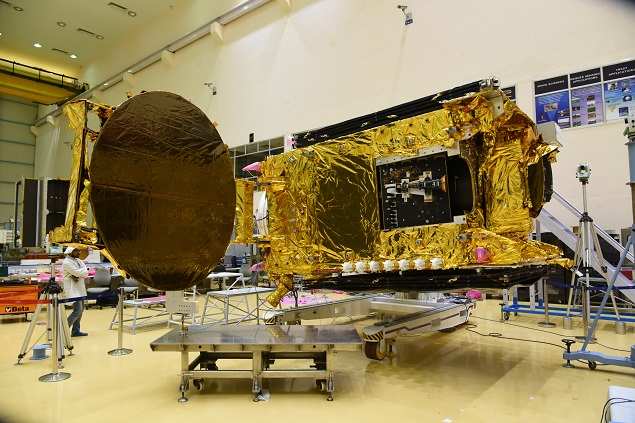
Indian Space Research Organisation's (ISRO) second mission of the year to place an earth observation satellite (EOS-3) by a GSLV rocket faced a setback. EOS-03 is the first state-of-the-art agile Earth observation satellite which was be placed in a Geosynchronous Transfer Orbit by GSLV-F10, as per ISRO. The GSLV-F10 mission was launched from Satish Dhawan Space Centre (SDSC), Sriharikota at 5:43 am on 12th August,2021. Performance of first and second stages was normal but the mission could not be accomplished fully upon technical anomaly in the cryogenic stage.
Later, ISRO Chairman K Sivan said, "(The mission) could not be fully accomplished mainly because there is a technical anomaly observed in the cryogenic stage. This I wanted to tell to all my friends."
The objective of this mission was to provide near real time imaging of large area region of interest at frequent intervals, for quick monitoring of natural disasters, episodic events and any short term events, and to obtain spectral signatures for agriculture, forestry, water bodies as well as for disaster warning, cyclone monitoring, cloud burst/ thunderstorm monitoring, etc. This launch was planned to take place in April-May but was pushed to August due to the COVID-19 outbreak.
As the news became public, netizens lauded ISRO and wished the space agency luck for its future missions.
The three entities placed their bids on July 30 after NewSpace India Limited (NSIL), a PSU operating under the Department of Space (DoS) issued an RFP (request for proposal) regarding the same. The NSIL was initially launched as a commercial arm of ISRO and later mandated with productionising launch vehicles, owning satellites and much more.
Three entities—a consortium led by the Adani Group, another one led by L&T and a single company are competing to acquire a PSLV contract for building five PSLV launch vehicles. This will be the first time when entities outside ISRO will build a launch vehicle end-to-end. This contract is likely to be awarded by the end of 2021 and the selected entity will be a licensed producer.
NSIL announced an expression of interest (EoI) for five PSLVs to which five entities had responded and the RFP for this was then issued in December 2020. “There were five players who responded to the EoI; three have submitted bids after the RFP just over three weeks,” a senior official told the Times of India publication.
The three entities – a consortium comprising Adani-Alpha Design, Bharat Electronics Limited (BEL) and Bharat Earth Movers Limited (BEML), another one including Hindustan Aeronautics Limited (HAL) and L&T have bid as group entities whereas Bharat Heavy Electricals Limited (BHEL) has bid for this contract as a single company. The contract is not only aimed at furthering the Centre’s Make-in-India but also at ramping up ISRO’s capabilities to launch more satellites in the coming years, as per a DoS communiqué.
“The techno-commercial evaluation is underway, after which the bids will be opened. We are hopeful of completing the whole process in a couple of months, and cannot comment on anything more at this juncture,” NSIL Managing Director and Chairman Radhakrishnan D said.
Finance MInister of India Nirmala Seetharaman on Saturday ( 16.5.2020 ) announced giving a role to private sector in India's space programmes which include satellites, launch vehicles, launches and space-based services.
For boosting the private sector in Indian space activities, the Government of India will provide level playing field for private companies in satellites and launch vehicles and other services. The Government will provide predictable policy and regulatory environment to the private players, she said while announcing the fourth tranche of the economicc stimulus package.
The start-ups and private firms will get a chance to use ISRO facilities and assets. This was announced by Finance Minister, Nirmala Seetharaman as she announced reforms for eight sectors amid corona virus pandemic.
So the private sector will be able to use ISRO facilities and other relevant assets to improve their capacities. "The future projects for planetary exploration and outer space travel would be open for the private sector", the Finance Minister said on her fourth press briefing of policy decisions after Prime Minister Narendra Modi earlier this week announced a Rs. 20 lakhs crores stimulus.
GSAT-30, India's first satellite of 2020 was successfully launched by European Space Agency's heavy lift launcher Arian 5 ( VA 251 ) from French Guiana at 02:35 am on Friday 17th January, 2020. GSAT-30 was placed into a geo synchronous orbit 38 minutes after lift off. The 3357 Kg GSAT-30 will serve as a replacement to INSAT-4A spacecraft services with enhanced coverage. The satellite will provide Indian main land with coverage in Ku Band and extended coverage in C-Band covering Gulf countries and large number of Asian countries and Australia. The mission life of this space craft is 15 years. For more details please click here.. Please see the video of the live launch below..
Black holes should be common in our Milky Way galaxy, but their dark nature means only dozens have been discovered to date. Here are a few nearby black holes astronomers know a little about.
By nature, it is impossible to see black holes directly. But astronomers can sense their presence by the way they interact with their environments, letting us glimpse these objects whose gravity is so strong that nothing can escape. In the past century, not only have astronomers shown that black holes do exist, but they’ve found dozens in our own galaxy.
However, based on the number of stars in our galaxy, there should actually be tens ofmillions out there. Let us now see the top 10 black holes which are closest to our Earth.
1. A0620-00, or V616 Monocerotis:
This black hole occassionally releases dramatic outbursts of X-Ray light. One of these happened in 1917 and that is how it was discovered. During the outburst in 1975 this black hole brightened over 1,00,000 times becoming the brightest X-Ray source at that time. Some of the details of this black hole are given below
It is about 3,500 light-years away
6.6 solar masses
Paired with a K-type main sequence star orbiting every 7.75 hours — less than the average work day
Its companion star is only around 40 percent of our sun’s mass. And the star is continually losing mass to the black hole, whose pull is so strong it’s squeezed into an ellipsoid instead of a sphere.
2. Cygnus X-1:
It is suspected by scientists that this black hole Cygnus X-1 began its life as a star 40 times the mass of our Sun. It is likely collapsed directly to form a black hole some 5 million years ago. Some details of this black hole are given below.
6,000 light-years away
14.8 solar masses
The black hole has an event horizon 185 miles across — about the length of New Hampshire.
Cygnus X-1’s companion star is a blue supergiant variable star that orbits every 5.6 days at just one-fifth of the sun-Earth distance.
3. V404 Cygni:
Scientists reported a wobble in giant jets of particles shot out by the black hole in V404 Cygni in 2019. They think this wobble could be caused by a black hole warping space-time. Some details of this black hole are given below.
7,800 light-years away
9 solar masses
Paired with an early K giant star that’s 70 percent as massive as our own sun, but six times larger in diameter.
4. GRO J0422+32:
This black hole is either the smallest ever found that formed from the collapse of star, or it could be a neutron star — the verdict is still out. Some details of this black hole are
7,800 light-years away
3.66 to 5 solar masses
Companion to an M-type main sequence star named V518 Per
5. Cygnus X-3:
The mass of this black hole is not well measured and the scientists are uncertain if Cygnus X-3 actually holds a black hole or a neutron star. The object is paired with a Wolf-Rayet star — an incredibly bright object with an unusual distribution of elements, particularly on its surface — that is one of the brightest stars in the galaxy. The star will likely become a black hole itself fairly soon, so stay tuned — for the next million years or so. Some details of this black hole are
20,00 light-years away
Roughly 2 to 5 solar masses
6. GRO J1655-40:
This black hole and star are traveling through the galaxy at 250,000 mph. For comparison, the sun cruises at only 44,740 mph. Astronomers think they achieved their breakneck pace when the black hole was created by an asymmetric supernova, which gave the system a kick. Some details of this black hole are
11,000 light-years away (perhaps much closer)
7 solar masses
Paired with an evolved F-type star that’s two times as massive as our sun.
The star and black hole are locked in an orbit every 2.6 days.
The black hole spins 450 times per second — fast enough to warp the space around it.
7. Sagittarius A*:
Sagittarius A* (pronounced A-star) is the Milky Way’s central supermassive black hole. It was first noticed in 1931, thanks to a radio signal coming from the center of the galaxy. But by observing the motions of nearby stars over decades, and watching clumps of gas near the object, astronomers have since firmly determined that it is indeed a supermassive black hole. What’s more, they now know most large galaxies also have them. Some details of this black hole are
25,640 light-years away
More than 4 million solar masses
8. 47 Tuc X9:
Scientists are still debating whether there’s actually a black hole in the globular cluster 47 Tucanae. Recent studies offer evidence for and against the idea. But, if it is there, it would be a rare example of a black hole in a globular cluster — something astronomers long thought was impossible. It would also have the closest orbit ever seen between a black hole and a star. Some details of this black hole are
14,800 light-years away
Mass unknown
Every 28 minutes, the black hole orbits its companion white dwarf star at a separation of just 2.5 times the distance between Earth and the moon.
9. XTE J1118+480:
Some details of this black hole are as follows.
5,000 to 11,000 light-years away
More than 6 solar masses
Paired with a star that packs just 20 percent of the sun’s mass
Suspected to have been formed by a metal-rich star that underwent a supernova
10. GS2000+25:
8,800 light-years away
7 solar masses
Paired with a late K-type star with 50 percent of the sun’s mass
We all know that largest dump on Earth is in Space.
In low Earth orbit — the space around our planet up to about 1,200 miles (2,000 kilometers) in altitude - There are more than 3000 satellites which are not functioning and tens of millions of smaller pieces of debris around the atmosphere. And each one of these is moving at tens of thousands of miles per hour Some times two big pieces of this debris crash into each other creating smaller fragments which is another junk in space. All these debris are moving at such high velocities that they can damage a space craft moving in the orbit.
So European Space Agency ( ESA ) has announced its plan to tackle this problem using robot hugs. In its mission known as ClearSpace-1, ESA will be launching an experimental, four-armed robot to collect a defunct satellite, hug it closely and then finally drag it on a kamikaze dive into Earth's atmosphere - destroying both devices.
The ClearSpace-1 Mission is scheduled to launch in 2025. It will test its robotic hugging muscles on a mid size piece of junk called Vespa. Which ESA's Vega launcher deposited about 800 Kms above Earth in 2013. The weight of that debris is 100 Kgs so it is relatively easy to capture on the robotic mission.
After capture of the Vespa, the robotic garbage collector and Vespa both will make a controlled yet fiery descent into Earth's atmosphere. The cost of this Mission is estimated to be around $135 millions.
Whether this is a cost-effective way or not, other nations and agencies are proposing other methods for removing debris like deploying tiny nets and using satellite mounted lasers to blast bits of space debris into atmosphere.
India’s Polar Satellite Launch Vehicle, in its fiftieth flight (PSLV-C48), successfully launched RISAT-2BR1, an earth observation satellite, along with nine commercial satellites of Israel, Italy, Japan and USA from Satish Dhawan Space Centre (SDSC) SHAR, Sriharikota.
PSLV-C48 lifted-off exactly at 1525Hrs (IST) on December 11, 2019 from the First Launch Pad of Satish Dhawan Space Center, Sriharikota. PSLV-C48 was the 75th launch vehicle mission from SDSC SHAR, Sriharikota. This is the 2nd flight of PSLV in 'QL' configuration (with 4 solid strap-on motors). Also this is the 50th PSLV flight of ISRO.
About 16 minutes and 23 seconds after lift-off, RISAT-2BR1 was injected into an orbit of 576 km at an inclination of 37 degree to the equator.
RISAT-2BR1 is a radar imaging earth observation satellite weighing about 628 kg. The satellite will provide services in the field of Agriculture, Forestry and Disaster Management. The mission life of RISAT-2BR1 is 5 years.
9 Commercial satellites were also successfully injected into designated orbit. These satellites were launched under commercial arrangement with NewSpace India Limited (NSIL), the commercial arm of Indian Space Research Organisation (ISRO).
India’s PSLV-C47 launch vehicle successfully launched India's Cartosat-3 and 13 commercial nanosatellites of USA from Satish Dhawan Space Centre (SDSC) SHAR, Sriharikota on 27th November, 2019.
PSLV-C47 lifted-off exactly at 09:28 Hrs (IST) on November 27, 2019 from the Second Launch Pad of SDSC SHAR, Sriharikota. PSLV-C47 was the 75th launch vehicle mission from SDSC SHAR, Sriharikota. This is the 21st flight of PSLV in 'XL' configuration (with 6 solid strap-on motors).
About 17 minutes and 38 seconds after lift-off, Cartosat-3 was injected into an orbit of 509 km at an inclination of 97.5 degree to the equator.
with the successful launch of CARTOSAT-3 on-board PSLV-C47 Rocket, ISRO has added one more to its constellation of remote sensing satellites which can map the earth with better accuracy. With this launch, ISRO so sar launch launched 8 nos of Cartosat Satellites since 2005, With this ISRO has launched 310 foreign satellites till now.
The United Kingdom is set to make its own giant leap soon, with a very small rover.
A 2.2-lb. (1 kilogram), four-legged robot built by London-based Spacebit will launch aboard Astrobotic's Peregrine moon lander in July of 2021, representatives of both companies announced recently.
It will be a flight of firsts — the first mission for both Peregrine and its rocket, United Launch Alliance's new Vulcan Centaur; the first trip to the moon's surface by a UK-built craft; and the first time a legged robot has explored another world.
The rover will be moving at least 10 meters on the surface of moon and beam high definition videos and other data to earth during its 10-earth-day mission. This mission is going to be just beginning. If all goes according to their plan, eventually Spacebit aims to launch a fleet of these little robots to explore the lunar sub surface to find out a suitable place for human settlement.
Spacebit's walking rover won't be flying alone on the July 2021 mission; it's one of about 30 payloads that Peregrine will carry to the lunar surface for a variety of customers. Fourteen of those payloads are from NASA
At exactly 9:57:30 am ( IST ) on Thursday, the 29th November, 2018 the ISRO's reliable workhorse PSLV rocket soared into the skies from Sriharikota's first launch pad carrying the India's first hyperspectral imaging satellite ( HysIS), an advanced earth observation satellite and 30 foreign satellites. During the 112 minute long mission, the PSLV-C43 first delivered India's primary satellite into the polar sun-synchronous orbit at an altitude of 630 Km 17 minutes and 19 seconds after the takeoff and then delivered the other 30 satellites after restarting the fourth stage engines twice. The last of the 30 satellites was injected into its designated orbit after 1 hour 49 minutes after lift off. HysIS is an earth observation satellite built around ISRO’s Mini Satellite-2 (IMS-2) bus weighing about 380kg. The mission life of the satellite is five years.
The 30 commercial satellites, including one micro and 29 nano satellites, are from eight countries. Of the total 30 satellites whose combined weight is 261.5 kg, 23 are from the US. For more details about the Mission, please click here.. Here is a video of the launch....
The second orbital test flight of India's heaviest launcher GSLV Mk3 took off on wednesday, 14th November, 2018 hoisting a high throughput communications satellite into orbit to connect the country's remote population and clearing the way for a robotic lunar lander to use the rocket in January.
The GSLV-Mk3-D2 rocket which is nearly 43.5 meters high lifted off from the Second Launch Pad at Satish Dhawan Space Center at exactly 11:38 GMT which is 05:08 PM local time at the India's space port. The payload of GSLV Mk3 D2 is a very advanced high-throughout satellite GSAT-29 which is a multi-beam communications satellite with a lift off mass of 3.4 tonnes. The payloads of this satellite caters to the communications requirements of users from remote areas of India. For more details please click here.
ISRO's work horse, PSLV in its 44th flight has put two UK earth observation satellites into the orbit on 16th September, 2018.
The Polar Satellite Launch Vehicle (PSLV-C42) of Indian Space Research Organisation (ISRO) successfully launched two satellites -- NovaSAR and S1-4 -- from the Satish Dhawan Space Centre (SDSC) SHAR, Sriharikota here on sunday, 16th September, 2018.
The PSLV-C42 lifted off from the First Launch Pad of Satish Dhawan Space Center, at 10.08 pm (IST). Both satellites were injected into the Sun Synchronous Orbit, about 17 minutes later, at an altitude of 583 km.
Both of these satellites belong o UK-based Surrey Satellite Technology Limited (SSTL), which has a contract with Antrix Corporation Ltd, the commercial arm of ISRO.
The NovaSAR is an S-band Synthetic Aperture Radar (SAR) and has an Automatic Identification Receiver payload. The satellite is intended for applications which include forestry mapping, land use and ice cover monitoring, flood and disaster monitoring and maritime missions. It will be operated from SSTL’s Spacecraft Operations Centre in Guildford, UK.
S1-4 is a high resolution earth observation satellite meant for surveying resources, environment monitoring, urban management and disaster monitoring.
This was the 44th flight of PSLV and the 12th flight of the Core Alone version of the vehicle. Core Alone is its lightest version without the six strap-on motors. It is used for launching smaller payloads.
In the 43rd flight of PSLV, ISRO's PSLV-C41 has successfully launched the 1425 Kg IRNSS-1I Navigation Satellite on 12th April, 2018 from Satish Dhawan Space Center, Sriharikota. The launch took place at 04:04 hrs IST The vehicle lifted off from the first launch pad as planned and after a flight time of 19 minutes, the vehicle achieved a GTO orbit with perigee of 281.5 Km and apogee of 20,730 Km inclined at an angle of 19.2 degrees to the equator after which the IRNSS-1I satellite was separated from PSLV. The IRNSS-1I is expected to replace IRNSS-1A, the first of the seven navigation satellites, that was rendered ineffective after its three rubidium atomic clocks failed.. The seven satellites are a part of the NavIC navigation satellite constellation. The video of the launch is shown below. .
ISRO successfully placed a communication satellite GSAT-6A into a geosynchronous transfer orbit. The satellite was carried onboard the GSLV-F08 launch vehicle from Satish Dhawan Space Center in Sriharikota on Thursday, March 29th, 2018 at 16:56 hrs IST The GSLV-F08 is the 12th flight of GSLV launch vehicle and sixth flight with indigenous cryogenic stage. The launch took place from the second launch pad at Satish Dhawan Space Center The GSAT-6A is a communication satellite that will complement the GSAT-6 which is already in orbit The diameter of the antenna of this satellite is 6 meters - it can be unfurled and opened like an umbrella once it reaches the prescriibed orbit and improve India's communication capabilities. The GSAT-6A is a high power S-band communication satellite and its mission life is about 10 years.
Tiangong-1 was the first space lab built by China and launched in late September, 2011 to help the nation master the technologies needed to construct and operate a crewed space station. China aims to have such a station up by 2020. The first Chinese orbital docking occurred between Tiangong-1 and an unpiloted Shenzhou spacecraft on 2nd Nov, 2011. Two crewed missions later visited Tiangong-1. Shenzhou9 and Shenzhou 10 which launched in June 2012 and June 2013. The European Space Agency has issued a new re-entry forecast for China's Tiangong-1 Space Lab. Th space lab weighing 8.5 tons is now expected to fall into Earth's atmosphere between 24th March, 2018 and 19th April, 2018. The ESA officials say it is a rough estimate. Re-entry will take place anywhere between 43 degrees north and 43 degrees south ( eg. Spain, France, Portugal, Greece etc) latitude. Areas outside these latitudes can be excluded. The precise location and time of fall cannot be predicted by ESA..
We all know that "Blue Moon" has nothing to do with the color of the Moon. A "Blue Moon" is some infrequent phenomenon which involves the appearance of an additional full moon within a given period. The period is something like two full moons appearing within a month's time. Normally there is a gap of 29.5 days between two full moons so it is very unusual for two ful moons to fit into a 3o or 31 day-long month ( means February will never have a blue moon). So a blue moon is a second full moon appearing within a single calendar month. This is the meaning of a blue moon. So a blue moon does not have associate blue color but a blue moon is a full moon which appears within the same calendar.
The next monthly Blue Moon will be on 31st March, 2018. The previous one was the Super Blue Moon on 31st January, 2018.
Origin of the term "Blue Moon".
The phrase "Once in a blue moon" has been around for more than 450 years according to Philip Hiscock, a folklorist at the Memorial University of NewFoundland. In a 2012 article in Sky&Telescope magazine, he explained that the earliest use of the term was much like saying the moon is made of green cheese - It indicated some thing absurd. "He would argue that the moon is blue" was similar to saying "He would argue that black is white".
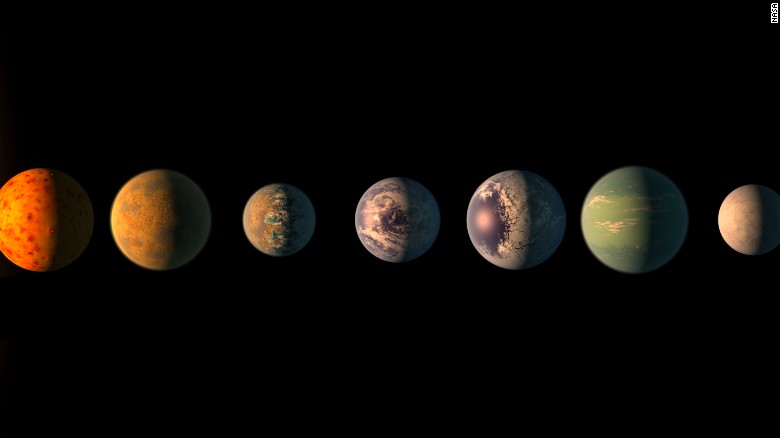
Astronomers have discovered seven earth-sized planets orbiting same star which is 40 light-years away according to a study published on wednesday ( 22nd Feb 2017) in the journal of nature. The discovery was announced at a news conference at NASA headquarters in Washington.
This discovery which is outside of our solar system is a rare event because the planets have the winning combination of being similar to the size of Earth and being all temperate, meaning they could have water on their surfaces and potentially support life.. The seven planets were all found in a tight formation around an ultra cool dwarf star called TRAPPIST-1. Some estimates indicate that they are rocky planets rather than being gaseous like Jupiter. Three planets are in habitable zone of the star and may even have oceans on their surfaces. These three planets are called as Trappist-1e, 1f and 1g. The researchers believe that Trappist-1f is the best candidate for supporting life. It is little bit cooler than Earth but can be suitable with the right atmosphere and enough green house gases. These planets are very close to each other and the star. They are all within five times within a space five times smaller than the distance from Mercury to our Sun. This proximity allows the researchers to make a study of the planets in depth as well, gaining insight about planetary systems other than our own. The seven planets of Trappist-1 are compared with Mercury, Venus, Earth and Mars. As we move away from the closest to the star to outwards, the planets have respective orbits from one and half to nearly 13 Earth days. The orbit of the farthest planet is still not known. If you stand on surface of one of the planets, you would receive 200 times less light than you get from the Sun, but you would still receive just as much energy to keep you warm since the star is so close.. It would also afford some views, as the other planets would appear in the sky as big as the moon. If you stand on Trappist-1f, the star would appear three times as big as the sun in our sky. The researchers believe that because of red nature of the star, the light would be a salmon hue. The researchers believe that the planets were formed together further from the star. Then they would have moved into their current lineup. Like our moon, the researchers believe that the planets closest to the star are tidally locked. This means that the planets always face one side to the star. One side of the planet is night and other side always day;. As per preliminary studies on climate, the researchers believe that the three planets which are closest to the star may be too warm to support liquid water, while the outermost planet, Trappist-1h, is probably too distant and cold to support water on the surface. Trappist-1 is a star which is half the temperature and a tenth of the mass of the Sun. It is red, dim and just a bit larger than Jupiter. But these tiny ultra cool stars are common in our galaxy. By using a global network ground-based telescopes like TRAPPIST and space-based telescopes like Spitzer, the researchers continued looking toward the Trappist system and were able to determine the orbits and orbital periods and distances of the planets from the star, their radius and their masses. The researchers are planning to define the atmosphere of each planet as well as determine whether they truly do have liquid water on their surface and search for life on these planets. All this would happen in the next decade. Even though 40 light years is not too distant, but it would take us millions of years to reach this star system. But for research purpose, it is a close opportunity and the best target to search for life beyond our solar system. James Webb Space Telescope will be launched i 2018 and positioned at a distance of 1 million miles from Earth with a view of the Universe. It can observe large exoplanets and detect starlight filtered through their atmosphere.. They are also searching for similar star systems to conduct atmosphere research. Four telescopes named SPECULOOS ( Search for habitable planets EClipsing ULtra-cOOl Stars) based in Chile will survey the southern sky for this purpose. This star system will probably outlive us because this type of star evolves so slowly. When out Sun dies, TRAPPIST-1 will still be young star and will live for another trillion years. After we are all gone, if there is another part of the Universe for life to carry on, it may be in the TRAPPIST-1 system.
The Indian Space Research Organisation made history once again by successfully launching PSLV-C37 Rocket with 104 satellites on-board there by creating a record of the most number of satellites in a single launch. This is the world record now.. This is yet another feather in the ISRO's cap, which has also launched the cheapest mission to MARS named Mangalyaan. The PSLV-C37 which was launched from Satish Dhawan Space Center at Sriharikota carried aboard the CARTOSAT-2Series satellite as well as 103 nano-satellites from various countries. The PSLV-C37 took off at 09:20 AM IST ( 03:58 GMT ) on 15th FEbruary, 2017 and cruised at a speed of 27,000 Kms per hour ejecting all the 104 satellites into the orbit in 30 minutes time. The main payload of PSLV-C37 was 714 Kg satellite for earth observation and it was also loaded with 103 nano satellites weighing around 664 kilograms in total. Three of the nano satellites are from India and the others are from countries including Israel, Kazakhstan, Netherlands, Switzerland, United Arab Emirates and 96 from USA. Now India holds the record of launching the most number of satellites in one go, surpassing Russia which launched 39 satellites in a single mission in June, 2014. The business of putting satellites into orbit for a fee is growing as phone, internet and other companies seek greater and more high-tech communications. ISRO is competing with other international players for a greater share of the space market and is well known for its low-cost space programme. The two solar arrays of Cartosat-2Series satellite were deployed automatically immediately after separation and the ISRO Telemetry, Tracking and Command Network at Bangalore took over the control of the satellite. The satellite will be made operational to its final configuration very soon and it will provide remote sensing services using its panchromatic ( black and white ) and multispectral ( color ) cameras. Out of the 103 satellites carried by PSLV-C37, two ISRO nano satellite-1 ( INS-1) weighing 8.4 Kg and INS-2 weighing 9.7 Kg are technology demonstration satellites from India. The remaining satellites are from other countries - USA ( 96), Netherlands ( 1), Switzerland ( 1), Israel (1), Kazakhistan (1) and UAE (1). With today's launch, the total number of customer satellites launched by India has reached 180.
The list of satellites 104 is given below...
CartoSat-2D – ISRO, India (1)
CartoSat-2D is fifth in the series of CartoSat-2 remote-sensing satellites that capture and
send panchromatic and multispectral images of India from space. These images can be used
to monitor the coastal land use, urban and rural planning, road networks and water distribution
, and to identify natural and man-made features. Weighing 714 kilograms, ISRO’s CartoSat-2D
is the heaviest satellite onboard the PSLV-C37 and accounts for more than half the 1,377
kilogram payload of the rocket.
INS-1A – ISRO, India (1)
ISRO Nano Satellite-1A is an 8.4-kilogram research satellite that will stay operational for six
months, and carry two science payloads. One is the Surface BRDF Radiometer (SBR) payload
that can be used measure the Bidirectional Reflectance Distribution Function (BRDF) of targets
on the Earth's surface and will be able to take readings of the sunlight reflected off different
surface features. The other is the Single Event Upset Monitor (SEUM), which can be used to
track Single Event Upsets that happen due to high energy radiation in space environment in
Commercial, Off-the-Shelf (COTS) electronic components.
INS-1B – ISRO, India (1)
ISRO Nano Satellite-1B aboard the new PSLV-C37 rocket is also a modular satellite similar to
the INS-1B, but weighs 9.7 kilogram. It is expected to remain operational for 6-12 months and
also carries two science payloads: the Earth Exosphere Lyman Alpha Analyser (EELA) and
Origami Camera payload from ISRO's Space Application Centre (SAC). EELA keeps track of
terrestrial exospheric line-of-sight neutral atomic hydrogen Lyman Alpha flux and can give an
estimate for the interplanetary hydrogen Lyman Alpha background flux by means of deep
space observations. The Origami Camera, on the other hand, is a remote sensing colour
camera that can take high-resolution pictures of the Earth with a small package.
Flock-3p – Plant Labs, United States of America (88)
ISRO’s PSLV-C37 will take Planet Labs’ 88 Flock-3p nano-satellites to space, bringing the total
number of Dove satellites in space to 100. The satellites will be able to capture images of the
entire Earth surface once a day and take pictures in line-scanner formation at mid-morning
pass times to minimise shadows in the images they capture.
Lemur-2 – Spire Global, United States of America (8)
Eight Lemur-2 nano-satellites operated by Spire Global of the USA, each of which carries a
meteorological payload that can determine the atmospheric pressure, humidity and temp-
erature using signals from GPS satellites in Earth’s atmosphere. These nano-satellites also
carry a payload that allows them to monitor and send forward tracking data from seafaring
vessels.
Al-Farabi-1 – Al-Farabi Kazakh National University, Kazakhstan (1)
The Al-Farabi-1 is a nano-satellite developed by students of the Kazakhstan’s Al-Farabi
Kazakh National University. It weighs 1.7 kilograms and will work on calculating uplink /
downlink and ADCS Mission algorithms and testing of self-made components.
BGUSat – Ben Gurion University, Israel (1)
A 3U CubeSat nano-satellite developed by Israel’s Ben Gurion University, BGUSat carries
two imaging payloads, an experimental GPS receiver and an optical communication expe-
riment. It measures 10x10x30 centimetres and weighs 5 kilograms. The BGUSat’s cameras
can track climate phenomena and its guidance system enables the operators choose the
areas to shoot and research through a dedicated ground station at BGU.
Nayif-1 – Emirates Institution for Advanced Science and Technology (EIAST), UAE (1)
Students at UAE’s Emirates Institution for Advanced Science and Technology (EIAST) deve-
loped the Nayif-1 nano-satellite and will be used for educational purposes.
DIDO-2 – SpacePharma, Israel and Switzerland (1)
DIDO-2 is a microgravity research nano-satellite that can be used to conduct biochemical
and physical experiments in micro-gravity. It will serve pharmaceutical companies, as well as
other organisations, and will be able to send back data to Earth-based researchers via the
on-board microscope.
PEASS – PEASS Consortium, Netherlands, Germany, Belgium, and Israel (1)
PiezoElectric Assisted Smart Satellite Structure or PEASS is a nano-satellite that can be
used to evaluate and qualify ‘smart structures’ which combine composite panels, piezo-
electric materials, and next-generation sensors.
The launch video is shown below..
Here is a video of the onboard camera where we can see all the events till seperation of all the satellites.
Once again India's PSLV delivered to orbit on Wednesday ( 7th December, 2016) the country's third space mission dedicated to mapping of natural resources creating a record year for Indian launch hitory. The Resurcesat-2A was launched by India's PSLV rocket ( PSLV-C36) in its 38th flight successfully at 10:25 hrs IST on 7th December, 2016. The satellite weighed 1235 Kg. The 36 hur count down began on monday and the ground crew filled the PSLV's second and fourth stages with liquid fuels. The PSLV-C36 lifted off at 04:55 GMT and climbed through a heavy rain shower and low clouds from the First Launch Pad of Satish Dhawan Space Center with 1.7 million pounds of thrust. The first four of the 12 meter auxiliary motors ( strap-on motors ) burned out and jettisoned around 70 seconds after lift-off followed by release of the last pair of boosters at T+92 seconds. The first stage of the rocket consumed the solid propellant by T+1 minute and 50 seconds giving way to the Rocket's hydrazine-burning second stage Vikas Engine around 74 kilometers above Earth for a firing which lasted about 2 and 1/2 minutes with 1,80,000 pounds of thrust. The onboard computers began closed-loop guidance during the second stage burn and the rocket's 3.2 meter diameter payload fairing fell down from the rocket at T+150 seconds. The PSLV headed eastwards first and then turned south in a "dogleg" maneuver to avoid flying over Sri Lanka accelerating to orbital velocity over Indian Ocean. Once the Vikas Engine ( second stage ) emptied its 42 metric tonne supply of hydrazine and nitrogen tetroxide propellants, the third stage ignited around T+4 minutes 23 seconds for nearly two minutes and then coasted off until separating from the Rocket's fourth stage at around T+ 8 minutes 41 seconds.
The twin engine liquid fueled fourth stage took control of the mission at T+ 8 minutes 51 seconds for an eight minute firing to obtain proper velocity to enter the targeted polar orbit. Resourcesat-2A was separated at around 18 minutes after lift-off. The Resourcesat-2A will track agriculture, water resources, soil contamination and the growth of Indian cities. This is a follow up for Resourcesat 1 and Resourcesat 2 launched earlier in 2003 and 2011. The spacecraft was put into an orbit of 823 Kms high at an inclination of 98.7 degrees to equator. The PSLV-C36 launched on wednesday demonstrated several upgrades to the PSLV's avionics systems including the improved navigation system, a fiber-optic gyroscope, indigenously-produced computer processors and an automated fueling system to the fourth stage. The streamlined automatic fuelling system saved one day in the launch preparations and also for a safe work environment for ground engineers to prepare the rocket. Here is a video of PSLV-C36 Launch ....
Again Indian Space Research Organization has made history by placing eight satellites into two different orbits in a single mission using PSLV-C35 Rocket. In its 37th flight ( PSLV-C35) india's Polar Satellite Launch Vehicle has successfully launched the 371 Kg SCATSAT-1 along with seven co-passenger satllites on 26th September, 2016 from its space port Satish Dhawan Space Center, Sriharikota This is the 36th consecutive successful flight of PSLV. The total weight of the satellites is 675 Kg. This is the first mission of PSLV to launch satellites into two different orbits and also this is the longest mission of PSLV till date and completed in 2 hours 15 minutes and 33 seconds after lift off. The PSLV-C35 lifted off at 09:12 hrs IST from the First Launch Pad of Satish Dhawan Space Center located at Sriharikota, Andhra Pradesh. All the events like strap-on ignitions and separations, first stage separation, second stage ignition and separation, third stage ignition and separation, payload fairing separation, fourth stage ignition and cut-off took place as planned. After 16 minutes and 56 seconds, the vehicle achieved a polar sun synchronous orbit of 724 Km with an inclination at an angle of 98.1 degrees to the equator and 37 seconds later the primary satellite SCATSAT-1 got separated. The two solar panels were deployed after separation of SCATSAT-1 and ISTRAC at Bangalore took the control of the satellite. The satellite would provide weather related information using scatterometer payload. The data would be useful in weather forecasting services as well as cyclone detection and tracking. The PSLV mission continued after separation of SCATSAT-1 carrying the other 7 satellites. The 4th stage coasted over the south pole and started ascending towards northern hemisphere. After 1 hour 22 minutes 38 seconds after lift-off as the fourth stage was in North Pole region, the two engines of fourth stage were reignited and fired for 20 seconds. Due to this firing, the rocket entered into an elliptical orbit of 725 Km x 670 Km. The PSLV once again was coasting near south pole after 50 minutes, the engines were fired once again for 20 seconds. This second firing made the fourth stage to enter into a circular orbit of 669 Km height inclined at 98.2 degrees to the equator. After 37 seconds, the dual launch adopter was successfully separated from PSLV-C35 fourth stage. 30 seconds later, ALSat1N satellite got separated. Following this, the NLS-19, PRATHAM, PISAT, ALSAT-1B, and Path finder-1 were separated in a pre determined sequence. PRATHAm weighing 10 Kg and PISAT weighing 5.25 Kg were made by Indian universities and academic institutions with the involvement of students of IIT Mumbai and PES University, Bangalore. Here is a video of PSLV-C35 Launch.....