Finance MInister of India Nirmala Seetharaman on Saturday ( 16.5.2020 ) announced giving a role to private sector in India's space programmes which include satellites, launch vehicles, launches and space-based services.
For boosting the private sector in Indian space activities, the Government of India will provide level playing field for private companies in satellites and launch vehicles and other services. The Government will provide predictable policy and regulatory environment to the private players, she said while announcing the fourth tranche of the economicc stimulus package.
The start-ups and private firms will get a chance to use ISRO facilities and assets. This was announced by Finance Minister, Nirmala Seetharaman as she announced reforms for eight sectors amid corona virus pandemic.
So the private sector will be able to use ISRO facilities and other relevant assets to improve their capacities. "The future projects for planetary exploration and outer space travel would be open for the private sector", the Finance Minister said on her fourth press briefing of policy decisions after Prime Minister Narendra Modi earlier this week announced a Rs. 20 lakhs crores stimulus.
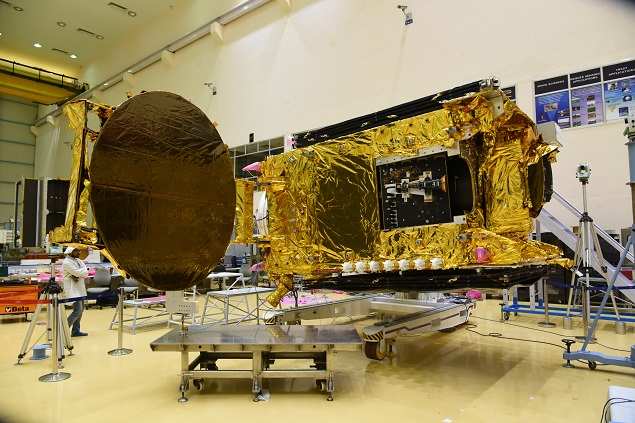
GSAT-30, India's first satellite of 2020 was successfully launched by European Space Agency's heavy lift launcher Arian 5 ( VA 251 ) from French Guiana at 02:35 am on Friday 17th January, 2020. GSAT-30 was placed into a geo synchronous orbit 38 minutes after lift off. The 3357 Kg GSAT-30 will serve as a replacement to INSAT-4A spacecraft services with enhanced coverage. The satellite will provide Indian main land with coverage in Ku Band and extended coverage in C-Band covering Gulf countries and large number of Asian countries and Australia. The mission life of this space craft is 15 years. For more details please click here.. Please see the video of the live launch below..
We all know that largest dump on Earth is in Space.
In low Earth orbit — the space around our planet up to about 1,200 miles (2,000 kilometers) in altitude - There are more than 3000 satellites which are not functioning and tens of millions of smaller pieces of debris around the atmosphere. And each one of these is moving at tens of thousands of miles per hour Some times two big pieces of this debris crash into each other creating smaller fragments which is another junk in space. All these debris are moving at such high velocities that they can damage a space craft moving in the orbit.
So European Space Agency ( ESA ) has announced its plan to tackle this problem using robot hugs. In its mission known as ClearSpace-1, ESA will be launching an experimental, four-armed robot to collect a defunct satellite, hug it closely and then finally drag it on a kamikaze dive into Earth's atmosphere - destroying both devices.
The ClearSpace-1 Mission is scheduled to launch in 2025. It will test its robotic hugging muscles on a mid size piece of junk called Vespa. Which ESA's Vega launcher deposited about 800 Kms above Earth in 2013. The weight of that debris is 100 Kgs so it is relatively easy to capture on the robotic mission.
After capture of the Vespa, the robotic garbage collector and Vespa both will make a controlled yet fiery descent into Earth's atmosphere. The cost of this Mission is estimated to be around $135 millions.
Whether this is a cost-effective way or not, other nations and agencies are proposing other methods for removing debris like deploying tiny nets and using satellite mounted lasers to blast bits of space debris into atmosphere.
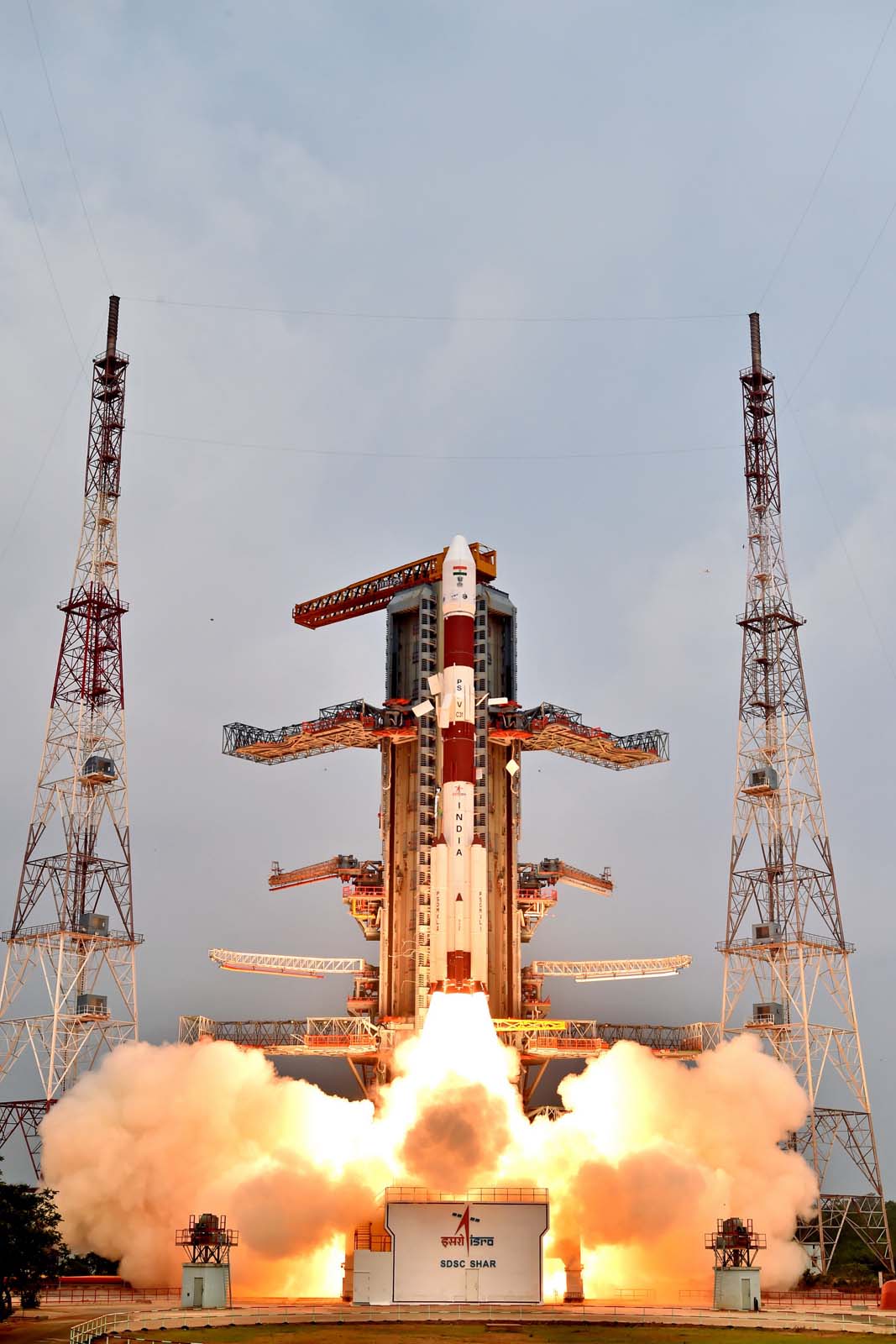
India’s Polar Satellite Launch Vehicle, in its fiftieth flight (PSLV-C48), successfully launched RISAT-2BR1, an earth observation satellite, along with nine commercial satellites of Israel, Italy, Japan and USA from Satish Dhawan Space Centre (SDSC) SHAR, Sriharikota.
PSLV-C48 lifted-off exactly at 1525Hrs (IST) on December 11, 2019 from the First Launch Pad of Satish Dhawan Space Center, Sriharikota. PSLV-C48 was the 75th launch vehicle mission from SDSC SHAR, Sriharikota. This is the 2nd flight of PSLV in 'QL' configuration (with 4 solid strap-on motors). Also this is the 50th PSLV flight of ISRO.
About 16 minutes and 23 seconds after lift-off, RISAT-2BR1 was injected into an orbit of 576 km at an inclination of 37 degree to the equator.
RISAT-2BR1 is a radar imaging earth observation satellite weighing about 628 kg. The satellite will provide services in the field of Agriculture, Forestry and Disaster Management. The mission life of RISAT-2BR1 is 5 years.
9 Commercial satellites were also successfully injected into designated orbit. These satellites were launched under commercial arrangement with NewSpace India Limited (NSIL), the commercial arm of Indian Space Research Organisation (ISRO).
India’s PSLV-C47 launch vehicle successfully launched India's Cartosat-3 and 13 commercial nanosatellites of USA from Satish Dhawan Space Centre (SDSC) SHAR, Sriharikota on 27th November, 2019.
PSLV-C47 lifted-off exactly at 09:28 Hrs (IST) on November 27, 2019 from the Second Launch Pad of SDSC SHAR, Sriharikota. PSLV-C47 was the 75th launch vehicle mission from SDSC SHAR, Sriharikota. This is the 21st flight of PSLV in 'XL' configuration (with 6 solid strap-on motors).
About 17 minutes and 38 seconds after lift-off, Cartosat-3 was injected into an orbit of 509 km at an inclination of 97.5 degree to the equator.
with the successful launch of CARTOSAT-3 on-board PSLV-C47 Rocket, ISRO has added one more to its constellation of remote sensing satellites which can map the earth with better accuracy. With this launch, ISRO so sar launch launched 8 nos of Cartosat Satellites since 2005, With this ISRO has launched 310 foreign satellites till now.
The United Kingdom is set to make its own giant leap soon, with a very small rover.
A 2.2-lb. (1 kilogram), four-legged robot built by London-based Spacebit will launch aboard Astrobotic's Peregrine moon lander in July of 2021, representatives of both companies announced recently.
It will be a flight of firsts — the first mission for both Peregrine and its rocket, United Launch Alliance's new Vulcan Centaur; the first trip to the moon's surface by a UK-built craft; and the first time a legged robot has explored another world.
The rover will be moving at least 10 meters on the surface of moon and beam high definition videos and other data to earth during its 10-earth-day mission. This mission is going to be just beginning. If all goes according to their plan, eventually Spacebit aims to launch a fleet of these little robots to explore the lunar sub surface to find out a suitable place for human settlement.
Spacebit's walking rover won't be flying alone on the July 2021 mission; it's one of about 30 payloads that Peregrine will carry to the lunar surface for a variety of customers. Fourteen of those payloads are from NASA
ISRO's work horse, PSLV in its 44th flight has put two UK earth observation satellites into the orbit on 16th September, 2018.
The Polar Satellite Launch Vehicle (PSLV-C42) of Indian Space Research Organisation (ISRO) successfully launched two satellites -- NovaSAR and S1-4 -- from the Satish Dhawan Space Centre (SDSC) SHAR, Sriharikota here on sunday, 16th September, 2018.
The PSLV-C42 lifted off from the First Launch Pad of Satish Dhawan Space Center, at 10.08 pm (IST). Both satellites were injected into the Sun Synchronous Orbit, about 17 minutes later, at an altitude of 583 km.
Both of these satellites belong o UK-based Surrey Satellite Technology Limited (SSTL), which has a contract with Antrix Corporation Ltd, the commercial arm of ISRO.
The NovaSAR is an S-band Synthetic Aperture Radar (SAR) and has an Automatic Identification Receiver payload. The satellite is intended for applications which include forestry mapping, land use and ice cover monitoring, flood and disaster monitoring and maritime missions. It will be operated from SSTL’s Spacecraft Operations Centre in Guildford, UK.
S1-4 is a high resolution earth observation satellite meant for surveying resources, environment monitoring, urban management and disaster monitoring.
This was the 44th flight of PSLV and the 12th flight of the Core Alone version of the vehicle. Core Alone is its lightest version without the six strap-on motors. It is used for launching smaller payloads.
Tiangong-1 was the first space lab built by China and launched in late September, 2011 to help the nation master the technologies needed to construct and operate a crewed space station. China aims to have such a station up by 2020. The first Chinese orbital docking occurred between Tiangong-1 and an unpiloted Shenzhou spacecraft on 2nd Nov, 2011. Two crewed missions later visited Tiangong-1. Shenzhou9 and Shenzhou 10 which launched in June 2012 and June 2013. The European Space Agency has issued a new re-entry forecast for China's Tiangong-1 Space Lab. Th space lab weighing 8.5 tons is now expected to fall into Earth's atmosphere between 24th March, 2018 and 19th April, 2018. The ESA officials say it is a rough estimate. Re-entry will take place anywhere between 43 degrees north and 43 degrees south ( eg. Spain, France, Portugal, Greece etc) latitude. Areas outside these latitudes can be excluded. The precise location and time of fall cannot be predicted by ESA..
Once again India's PSLV delivered to orbit on Wednesday ( 7th December, 2016) the country's third space mission dedicated to mapping of natural resources creating a record year for Indian launch hitory. The Resurcesat-2A was launched by India's PSLV rocket ( PSLV-C36) in its 38th flight successfully at 10:25 hrs IST on 7th December, 2016. The satellite weighed 1235 Kg. The 36 hur count down began on monday and the ground crew filled the PSLV's second and fourth stages with liquid fuels. The PSLV-C36 lifted off at 04:55 GMT and climbed through a heavy rain shower and low clouds from the First Launch Pad of Satish Dhawan Space Center with 1.7 million pounds of thrust. The first four of the 12 meter auxiliary motors ( strap-on motors ) burned out and jettisoned around 70 seconds after lift-off followed by release of the last pair of boosters at T+92 seconds. The first stage of the rocket consumed the solid propellant by T+1 minute and 50 seconds giving way to the Rocket's hydrazine-burning second stage Vikas Engine around 74 kilometers above Earth for a firing which lasted about 2 and 1/2 minutes with 1,80,000 pounds of thrust. The onboard computers began closed-loop guidance during the second stage burn and the rocket's 3.2 meter diameter payload fairing fell down from the rocket at T+150 seconds. The PSLV headed eastwards first and then turned south in a "dogleg" maneuver to avoid flying over Sri Lanka accelerating to orbital velocity over Indian Ocean. Once the Vikas Engine ( second stage ) emptied its 42 metric tonne supply of hydrazine and nitrogen tetroxide propellants, the third stage ignited around T+4 minutes 23 seconds for nearly two minutes and then coasted off until separating from the Rocket's fourth stage at around T+ 8 minutes 41 seconds.
The twin engine liquid fueled fourth stage took control of the mission at T+ 8 minutes 51 seconds for an eight minute firing to obtain proper velocity to enter the targeted polar orbit. Resourcesat-2A was separated at around 18 minutes after lift-off. The Resourcesat-2A will track agriculture, water resources, soil contamination and the growth of Indian cities. This is a follow up for Resourcesat 1 and Resourcesat 2 launched earlier in 2003 and 2011. The spacecraft was put into an orbit of 823 Kms high at an inclination of 98.7 degrees to equator. The PSLV-C36 launched on wednesday demonstrated several upgrades to the PSLV's avionics systems including the improved navigation system, a fiber-optic gyroscope, indigenously-produced computer processors and an automated fueling system to the fourth stage. The streamlined automatic fuelling system saved one day in the launch preparations and also for a safe work environment for ground engineers to prepare the rocket. Here is a video of PSLV-C36 Launch ....
Again Indian Space Research Organization has made history by placing eight satellites into two different orbits in a single mission using PSLV-C35 Rocket. In its 37th flight ( PSLV-C35) india's Polar Satellite Launch Vehicle has successfully launched the 371 Kg SCATSAT-1 along with seven co-passenger satllites on 26th September, 2016 from its space port Satish Dhawan Space Center, Sriharikota This is the 36th consecutive successful flight of PSLV. The total weight of the satellites is 675 Kg. This is the first mission of PSLV to launch satellites into two different orbits and also this is the longest mission of PSLV till date and completed in 2 hours 15 minutes and 33 seconds after lift off. The PSLV-C35 lifted off at 09:12 hrs IST from the First Launch Pad of Satish Dhawan Space Center located at Sriharikota, Andhra Pradesh. All the events like strap-on ignitions and separations, first stage separation, second stage ignition and separation, third stage ignition and separation, payload fairing separation, fourth stage ignition and cut-off took place as planned. After 16 minutes and 56 seconds, the vehicle achieved a polar sun synchronous orbit of 724 Km with an inclination at an angle of 98.1 degrees to the equator and 37 seconds later the primary satellite SCATSAT-1 got separated. The two solar panels were deployed after separation of SCATSAT-1 and ISTRAC at Bangalore took the control of the satellite. The satellite would provide weather related information using scatterometer payload. The data would be useful in weather forecasting services as well as cyclone detection and tracking. The PSLV mission continued after separation of SCATSAT-1 carrying the other 7 satellites. The 4th stage coasted over the south pole and started ascending towards northern hemisphere. After 1 hour 22 minutes 38 seconds after lift-off as the fourth stage was in North Pole region, the two engines of fourth stage were reignited and fired for 20 seconds. Due to this firing, the rocket entered into an elliptical orbit of 725 Km x 670 Km. The PSLV once again was coasting near south pole after 50 minutes, the engines were fired once again for 20 seconds. This second firing made the fourth stage to enter into a circular orbit of 669 Km height inclined at 98.2 degrees to the equator. After 37 seconds, the dual launch adopter was successfully separated from PSLV-C35 fourth stage. 30 seconds later, ALSat1N satellite got separated. Following this, the NLS-19, PRATHAM, PISAT, ALSAT-1B, and Path finder-1 were separated in a pre determined sequence. PRATHAm weighing 10 Kg and PISAT weighing 5.25 Kg were made by Indian universities and academic institutions with the involvement of students of IIT Mumbai and PES University, Bangalore. Here is a video of PSLV-C35 Launch.....
The Indian Space Research Organisation ( ISRO ) on thursday, 8th September, 2016 successfully placed its advanced weather satellite INSAT-3DR using the GSLV-F05 Launch Vehicle.
This is the maiden operational flight of the heavy-duty Rocket GSLV-F05 of India fitted with indigenous cryogenic upper stage. The advanced weather satellite INSAT-3DR was successfully placed into the intended orbit by GSLV-F05 on thursday, 8th September, 2016 at exactly 16:50 hrs IST from the space port of India, Sriharikota.
The 49 meter GSLV-F05 lifted off from the second launch pad at Satish Dhawan Space Center, Sriharikota at 4:50 PM and injected the 2,211 Kg INSAT-3DR satellite into a Geosynchronous Transfer Orbit about 17 minutes later. It was origninally scheduled to lift off at 4:10 PM IST but due to a delay in Cryo stage filling operations, it was rescheduled to 4:50 PM.
The INSAT-3DR has a mission life of 10 years and will provide service continuity to earlier meterological satellites and further augment the capability to provide various meteorological, search and rescue services. This is the 10th GSLV flight and assumes significance because this is the first operational flight of GSLV fitted with Indian Cryo stage. Earlier GSLV launches were under developmental phase. GSLV-F05 marked a hat-trick of success for the indigenously developed Cryo stage after GSLV-D5 ( January, 2014) and GSLV-D6 ( August, 2015 ) missions which launched GSAT-14 and GSAT-6 satellites into space.
The orbit raising operations from Master Control Facility at Hasan were also successful. INSAT-3DR would supplement the services of INSAT-3D launched from French Guiana on 26th July, 2013. The payloads of this satellite are Imager, Sounder, Data-Relay Transponder and Satellite aided search and rescue transponder. The images would generate the images of Earth every 26 minutes and provide information about various parameters, sea surface temperature, snow cover, cloud motion winds. The sounder would provide informatio about temperature and humidity. The data relay transponder will be used for receiving meteorological, hydrological and coeanographic data. The satellite aided search and rescue transponder would pick up and relay alert signals originating from distress beacon of maritime, aviation, among others.
In an attempt to make the rockets lighter and carry heavier payloads, ISRO has planned to flight test the air-breathing rocket which will use atmospheric oxygen as fuel. Air breathing engines use atmospheric oxygen and burn it with the stored on-board fuel to generate the upward thrust. Conventional rockets carry both oxygen and fuel on board.
ISRO on 28th August, 2016 has successfully tested a pair of its scramjet engines - an air breathing ramjet in which combustion takes in a super sonic air flow. The engines were tested during a sub-orbital flight of Advanced Technology Vehicle ( ATV D02).
The total weight of the ATV rocket was 3270 Kgs and is based on Rohini-560 lifted off from Satish Dhawan Space Center, Sriharikota at 06:00 AM IST on 28th August, 2016. The total flight duration lasted about 5 minutes is the India's first experimental mission of the scramjet engine technology to develop indigenous air-breathing propulsion system..
During the flight, ISRO has tested the scramjet engines for five seconds. Once the second stage reached the desired conditions for start-up of the engine, the scramjet engines ignited and worked for about 5 seconds. The total mission of ATV-D02 ended with a planned touch down of the rocket in Bay of Bengal at about 320 Kilometers from Sriharikota. All the tests were conducted successfully as per ISRO statement. The scramjet engines which use atmospheric oxygen can cut the costs of rocket launches by reducing the amount of oxidizer needed to be carried along with the fuel. With this flight, India became the fourth country in the world to flight test a scramjet engine. This launch marks an important mile stone in Indian space programme. The mission which was earlier scheduled in July, 2016 was delayed due to the disappearance of Indian Air Force AN 32 plane on July 22, 2016 as many ships and aircrafts were patrolling the sea looking for the missing plane and people. Here is a video about ATV-D02 Mission.
A spy satellite NROL-61 of US National Reconnaissance Office, the Government Agency which oversees the country's spy satellite fleet which is to be launched on 28th July, 2016 has been mounted atop an Atlas 5 rocket on 20th July, 2016 morning. United Launch Alliance will perform the deployment mission on 28th July, 2016. The rocket will head in easterly direction away from Cape Canaveral along an initial flight azimuth of 99 degrees. The lift off of the Atlas 5 is planned at 08:37 AM EDT ( 12:37 GMT ) on 28th July, 2016. The duration of the visible launch window is a secret. but some source of information says that lift off may be at 1200 noon EDT ( 1600 GMT). The rocket will be operating in its 421 configuration with a 14 foot wide nose cone, two side-mounted solid boosters and a single engine Centaur upper stage. This is the first time NRO has has used the Atlas 5-421 rocket to launch one of its satellites. The payload was delivered to the vertical integration facility which is adjacent to the Complex 41 on 20th July, 2016 morning. The spy satellite was lifted off from its transporter by overhead crane and maneuvered atop the Centaur upper stage for mating. Some of the statistics of NROL-61 are listed below.
This is the 646th launch for Atlas program since 1957
This is 351st Atlas launch from Cape Canaveral
235th mission of a Centaur upper stage
212th use of Centaur by an Atlas rocket
The 470th production RL10 engine to be launched
The 13th RL10C-1 engine launched
The 70th flight of the RD-180 main engine
The 64th launch of an Atlas 5 since 2002
The 53rd launch of an Atlas 5 from Cape Canaveral
The 4th Atlas 5 launch of 2016
The 96th Evolved Expendable Launch Vehicle flight
The 13th National Reconnaissance Office use of Atlas 5
The 109th United Launch Alliance flight overall
The 56th Atlas 5 under United Launch Alliance
The 23rd NRO launch by United Launch Alliance
The 78th United Launch Alliance flight from Cape Canaveral
The 43rd 400-series flight of the Atlas 5
The 6th Atlas 5 to fly in the 421 configuration
The 45th NRO launch since acknowledging flights in 1996
In its 36th flight (PSLV-C34), the ISRO's Polar Satellite Launch Vehicle lifted off early Wednesday ( 22nd June, 2016 ) with an assortment of payloads for Indian Government, domestic universities, and institutions and companies from Indonesia, Canada, Germany and United States including a pathfinder satellite for Google's Terra Bella Earth observation mission.
The PSLV-C34 successfully launched the 727.5 Kg Cartosat-2 series satellites along with 19 other co-passengers on 22nd June, 2016 at 09:26 hrs IST. This is the 35th consecutive successful flight of PSLV and 14th in its 'XL' configuration. The total weight of all the satellites was 1288 Kgs. The launch occured at 03:56 GMT on Wednesday.. The 44 meter tall rocket, boosted by its six strap-on motors climbed into a clear sky, initially veering south east from the launch base, then turning south once over the bay of Bengal. The unusual trajectory, called a 'dogleg' maneuver, was required to avoid flying over Sri Lanka. Four of the strap-on motors were ignited at lift off, then the last pair fired at T+25 seconds moments later the PSLV accelerated faster than speed of sound. The first four strap-on motors were separated at T+70 seconds, followed by separation of other pair at T+92 seconds as the PSLV soars at an altitude of 47 Kilometers. The first stage motor burned out and separated at T+109 seconds and a fraction of a second later, the second stage's liquid fueled Vikas Engine turned on with a puff of exhaust visible to ground based cameras. The Vikas engine produced 180,000 pounds of thrust and burned 42 tons of Hydrazine and nitrogen tetroxide propellants during two-and-half minutes of operation. The heat shield or the payload fairing, fell down into two halves at T+155 seconds to reveal the 20 satellites packaged on top of the rocket.. The third stage solid motor ignited at T+4 minutes 22 seconds, at an altitude of 217 Kms. Finally a twin-engine liquid-fueled fourth stage assumed control of the mission at T+8 minutes 17 seconds for an eight minutes firing to reach the proper speed to enter the targeted polar orbit. Here is a video of the PSLV-C34 Launch...
On 23rd May, 2016, ISRO successfully flight tested the India's first winged body aerospace vehicle operating in hyperosonic flight regime. In this experimental mission, the HS9 solid rocket booster carrying the RLV-TD lifted off from the First Launch Pad at Satish Dhawan Space Center, Sriharikota at 07:00 hrs IST on 23rd May, 2016. After successful flight of 91.1 seconds, the HS9 was burnt out following which both HS9 and RLV-TD mounted on its top coasted to a height of about 56 Kms. At this height, the RLV-TD separated from HS9 booster and further ascended to a height of about 65 Km.
From the height of 65 Kms, the RLV-TD started its descent followed by atmospheric re-entry at around Mach 5 ( five times speed of sound ). The navigation, guidance and control system of the vehicle steered it during this phase for safe descent. After successfully surviving the high temperatures of re-entry with help of thermal protection system, the RLV-TD successfully landed at the defined landing spot over Bay of Bengal which is at a distance of 450 Km from Sriharikota. The total flight duration from launch to landing lasted for about 770 seconds. Some of the critical technologies like autonomous navigation, guidance and control, reusable thermal protection system and re-entry mission management were successfully validated. The final version of RLV would take about 10 to 15 years to get ready. Here is a video of the RLV TD launch...
In the 35th flight of PSLV ( PSLV-C33) of ISRO has launched the 1425 Kg IRNSS-1G, the 7th satellite in the Indian Regional Navigation Satellite System (IRNSS) on 28th April, 2016 from Satish Dhawan Space Center, Sriharikota. This is the 34th consecutive successful mission of PSLV and the 13th in its 'XL' configuration. Honourable Prime Minister of India, Sri Narendra Modi congratulated all the ISRO scientists and the team ISRO for completing the IRNSS constellation and dedicated the IRNSS system to the nation and named it as "NavIC" ( Navigation Indian constellation ). The PSLV-C33 lifted off at 12:50 Pm IST from the first launch pad with the ignition of first stage, the subsequent flight events took place as planned. After 19 minutes and 42 seconds, the IRNSS-1G spacecraft was injected into the elliptical orbit of 283 Km x 20718 Km inclined at an angle of 17.867 degrees to the equator. After separation, the solar panels of the IRNSS-1G were deployed automatically and ISRO's Master Control Facility at Hasan took over the control of the spacecraft. The orbital manoeuvres were conducted by MCF and the satellite was finally placed into Geo stationary orbit at 129.5 degrees East longitude. IRNSS-1G is the seventh and the last satellite in the IRNSS constellation. Here is a video of the PLSV-C33 Launch..
India has launched the 1425 Kg IRNSS-1F, the sixth satellite in the Indian Regional Navigation Satellite System ( IRNSS) on 10th March, 2016 afternoon. This is the 34th flight of PSLV launch vehicle. The launch took place from India's space port, Sriharikota. This is the 12th PSLV flight in its 'XL' configuration.
After the lift off at 16:01 IST from Second launch pad with the ignition of first stage, the subsequent important flight events took place as planned. The IRNSS-1F satellite was injected to an elliptical orbit of 284 Km x 20719 Km inclined at an angle of 17.866 degrees to the equator after 19 minutes 14 seconds. The solar panels of the spacecraft were deployed automatically after separation. ISRO's Master Control Facility at Hasan took over the control of the satellite and placed the satellite into a Geostationary orbit at 32.5 degree East longitude. This is the 6th of the seven satellites constituting the space segment of Indian Regional Navigation Satellite system. IRNSS-1A, 1B, 1C, 1D and 1E were the first five satellites of the constellation were successfully launched by PSLV on July 02, 2013, April 04, 2014, October 16, 2014, March 28, 2015 and January 20, 2016 respectively. The IRNSS is an independent regional navigation system designed to provide position information in the Indian region and 1500 Km around the Indian main land. The IRNSS would provide two types of services namely, Standard positioning services (SPS)- provided to all users and Restricted Services ( RS ) provided to authorized users.
There are a number of ground stations responsible for the generation and transmission of navigation parameters, satellite ranging and monitoring etc. 18 stations have been established across the country. Here is a video of the PSLV-C32 LAUNCH...
ISRO has launched PSLV-C31 rocket on Wednesday, 20th January, 2016. The Rocket carried the fifth navigtion satellite of India - IRNSS-1E and launched it into its orbit. With this launch, India is closer to having its own global positioning system (GPS). Two more satellites are to be launched in this constellation.
The PSLV-C31 blasted off from the Second Launch Pad of the Space port of India - Sriharikota as per schedule. The rocket took off at 9:31 AM IST. The life span of the satellite is 12 years. The constellation of 7 satellites is planned to be completed this year itself. The full system comprises of 9 satellites - seven in the orbit and two on the ground as stand-by. The first satellite in the constellation - IRNSS-1A was launched in July, 2013, the second in April, 2014, the third in October, 2014 and the fourth one was launched in March, 2015. Once the Regional Navigation System, India need not depend on other platforms for GPS services. The IRNSS satellites two types of payloads - One is Navigation payload and the other is Ranging payload. The navigation payload of IRNSS-1E will transmit navigation signals to the users. This payload will operate in L5 band and S-Band.
A highly accurate rubidium atomic clock is a part of the navigation payload. The ranging payload of this satellite consists of C-band transponder which facilitate accurate range of the satellite. The IRNSS-1E also carries corner cube retro reflectors for laser ranging.
As PSLV-C31 soared into the blue sky at the end of 48 hours count down, all the four stages of the launch vehicle executed their functions as expected. The two solar panels of IRNSS-1E were deployed automatically after injection of the satellite into the geo transfer orbit. The orbit raising operations would be done from the Master Control Facility in Karnataka. The weight of IRNSS-1E is 1,425 Kg.
Here is a live video showing the launch of PSLV-C31.
The ISRO has given its country a perfect Diwali Gift - An indigeneously developed communications Satellite GSAT-15 was successfully launched at 03:04 AM ( IST ) today. The satellite was launched using one of the largest rockets of the world - The Ariane-5. The launch took place from Kourou in French Guyana in South America.
The GSAT-15 is 3164 Kg in weight and costed about Rs. 278 crores to make it. The satellite carries 24 transponders which helps in Direct to Home (DTH) broadcasting. The GSAT-15 also carries a GPS Aided GEO Augmented Navigation (GAGAN) payload which operates in L1 and L5 bands which helps in aircraft navigation. The Ariane-5 rocket was hired at a cost of Rs. 580 crores. Another satellite ARABSAT communications satellite also accompanied GSAT-15 in the same launch. The GSAT-15 was launched into a GTO orbit after Arabsat was injected into space.
India has shortage of transponders at present in space. Only 1/3 of the required capacity is being handled by Indian Satellite System. The rest is being leased from foreign satellite owners. After a smooth countdown of 11 hours and 30 minutes the Ariane-5 lifted off at the scheduled time./
The live video of the GSAT-15 launch can be seen below.
ESA deployed "big iron" to communicate with its deep-space missions. Three 35-m diameter dishes employing some of the world's most advanced tracking technology. The three Deep Space Antenna stations of ESA located at New Norcia, Australia, Cebreros, Spain and Malargue, Argentina send commands and receive data from spacecrafts travelling hundreds of millions of kilometers into solar system.
The three stations form a part of ESA's Estrack network which is a global system of stations providing links between satellites in orbit and the European Space Operations Center, Darmstadt, Germany, The core network comprise of 10 stations in 7 countries.
The huge dish antennae whose movable structures weigh around 620 tonnes - can be elevated, rotated and aimed with great accuracy in spite of high winds and heat and transmit radio signals upto 20 KW power - enough to run over 20,000 domestic coffee makers. They make use of advanced, made in Europe Electronics, including cryogenically cooled low-noise amplifiers ( LNA) and exquisitely machined mirrors made of metal.